
Practice Areas
Patent & Utility Model
1.
Overview
The Republic of Korea is a member of the Patent Cooperation Treaty (PCT) and the Paris Convention, and a Contracting Party to the Budapest Treaty.
Korean patent law is based on a first-to-file system. A patent may be granted when the invention satisfies the statutory requirements, including novelty, inventive step, and industrial applicability.
For a PCT application designating Korea, the international filing date is recognized as the filing date for the Korean national phase, subject to the requirements of the Korean Patent Act.
A PCT application must generally enter the Korean national phase within 31 months from the priority date. The Korean national phase requires submission of the prescribed national-phase documents and, where applicable, a Korean translation of the international application.
Applicants who do not have a residence or business address in Korea must appoint a Korean patent attorney to act on their behalf in patent-related procedures.
2.
Preparation and Power of Attorney
To file a patent application in Korea, applicants should provide the necessary application information and, where representation is required, a duly executed Power of Attorney (POA).
A filing date is particularly important when claiming priority or when other statutory deadlines are involved. Accordingly, all filing instructions and documents should be prepared carefully and provided to us sufficiently in advance of the relevant deadline.
A missing POA or other formal information may, depending on the circumstances, be supplemented after filing in response to an official notice.
3.
Required Information and Documents for Filing
The following information and documents are generally required for filing a Korean patent application:
(a) Applicant Information: Full name or corporate name; full address; nationality; and, for a corporation, the legal name and address of its principal office.
(b) Inventor Information: Full name of each inventor, address, and nationality.
(c) Specification, Claims, Abstract and Drawings: The patent application should contain the title of the invention, a detailed description of the invention, claims, an abstract, and drawings where necessary. The specification and claims should be prepared in accordance with the requirements of the Korean Patent Act and its examination practice. For a Korean-language filing, the application documents must be submitted in Korean.
(d) Power of Attorney: A duly executed Power of Attorney may be required when a Korean patent attorney represents the applicant. If the POA is not submitted at the time of filing, it may generally be supplemented after filing upon request by the Korean Intellectual Property Office (MOIP/KIPO).
(e) Priority Document: If Convention priority is claimed, the priority information should be indicated at the time of filing. For a Korean patent application claiming foreign priority, the priority document may be submitted within one year and four months from the earliest priority filing date. If the required priority document is not submitted within the prescribed period, the priority claim may become ineffective. A Korean translation of the priority document is not automatically required in every case; it may be requested where the examiner considers it necessary for substantive examination.
(f) Microorganism Deposit Certificate: If the invention involves a microorganism for which a deposit is required, the relevant deposit information and supporting documentation should be provided in accordance with the Korean Patent Act and applicable international treaty requirements.
4.
PCT National Phase Entry
For a PCT application entering the Korean national phase, the following should be noted:
(a) Deadline: The Korean national phase must generally be entered within 31 months from the priority date. Failure to enter the national phase within the prescribed period may result in the international application being deemed withdrawn in Korea.
(b) Korean Translation: The description, claims, drawings containing text, and abstract of the international application generally need to be submitted in Korean for entry into the Korean national phase. Under the current procedure, an applicant may request an extension of the period for submitting the Korean translation at the time of national-phase entry; if properly requested, the translation may be submitted within 32 months from the priority date. If the international application was filed in Korean, a Korean translation is not required.
(c) National Phase Documents: The principal documents for Korean national-phase entry include the prescribed national-phase filing document under Article 203 of the Korean Patent Act; a Korean translation of the international application, where required; a Power of Attorney, where applicable; and priority information and related documents, where required. A separate copy of the PCT publication cover page is generally not required as a substantive filing document under the current national-phase procedure.
(d) Changes in Applicant or Inventor Information: If there have been changes in the applicant's or inventor's name, address, nationality, ownership, or other relevant particulars during or after the international phase, please notify us before the Korean national-phase entry whenever possible. This enables the Korean national-phase documents and bibliographic information to be prepared consistently with the current status of the international application.
5.
Examination of a Korean Patent Application
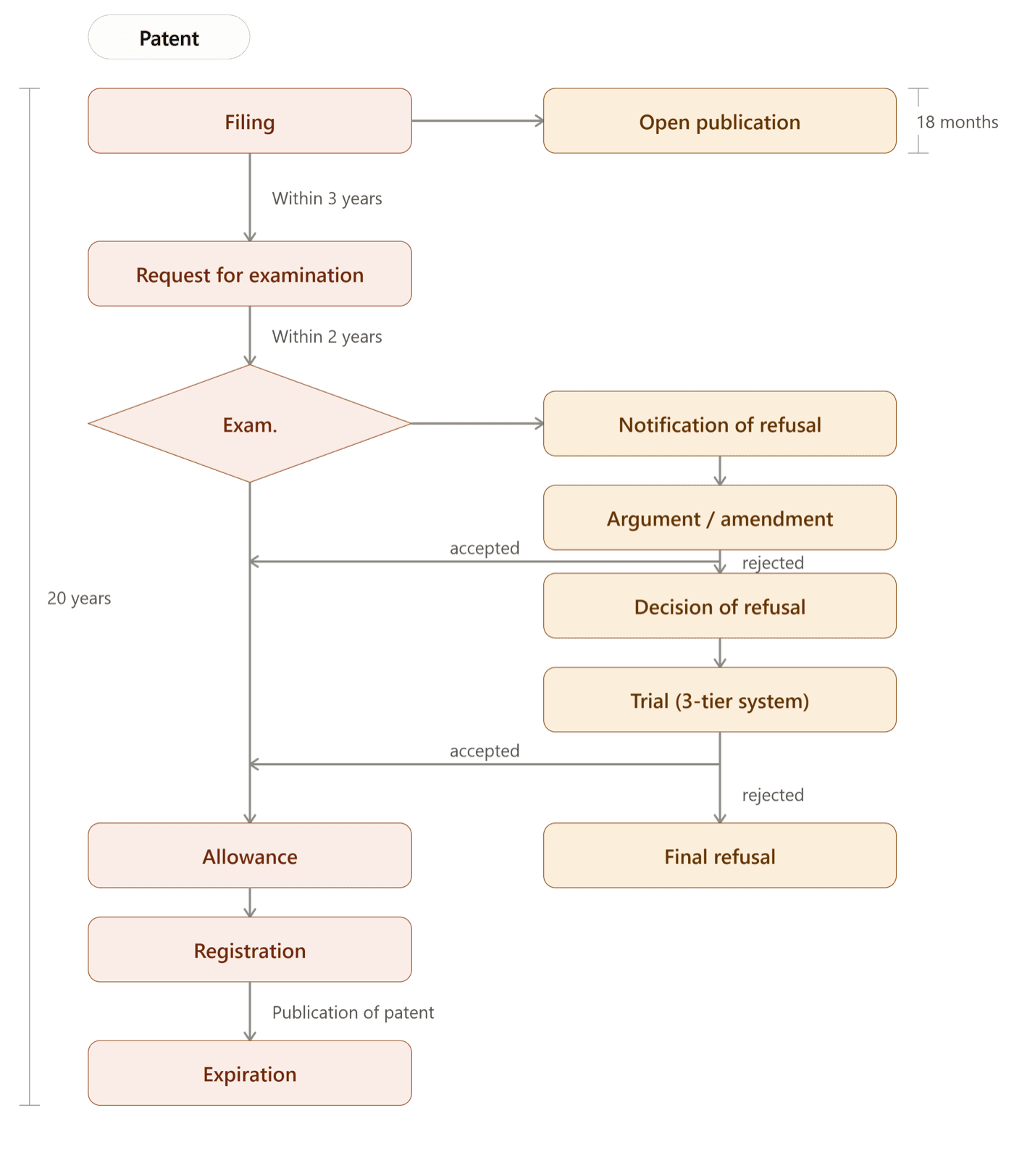
Korea conducts substantive examination of patent applications. A patent application is examined for requirements including patentable subject matter; industrial applicability; novelty; inventive step; sufficient disclosure and clarity; and other statutory requirements.
A request for substantive examination must generally be filed within five years from the Korean filing date. If no request for examination is filed within the prescribed period, the application is deemed to have been withdrawn.
Patent applications are generally laid open for public inspection 18 months from the Korean filing date or the priority date, whichever is applicable, unless an earlier publication is requested.
6.
Office Actions and Responses
If the examiner identifies grounds for rejection, the applicant is given an opportunity to respond by submitting arguments and, where appropriate, amendments to the specification, claims, and/or drawings.
Depending on the stage of prosecution, an applicant may also have access to procedures such as re-examination after amendment or an appeal against a final rejection.
The applicable response period and available remedies depend on the type and timing of the official notice.
7.
Grant and Registration
If the examiner determines that the application satisfies all requirements for patentability, a decision to grant a patent is issued.
Following the decision to grant, the applicant must pay the prescribed registration fee within the applicable period. Upon payment and registration of the establishment of the patent right, the patent right becomes effective.
The patent term generally ends 20 years from the filing date of the patent application, subject to statutory extensions that may apply in certain circumstances.
8.
Practical Considerations for Foreign Applicants
For foreign applicants, the following points are particularly important:
1. Use a Korean patent attorney if the applicant has no residence or business address in Korea.
2. Observe the 31-month PCT national-phase deadline strictly.
3. Prepare the Korean translation carefully, particularly the claims and technical terminology.
4. Provide complete and accurate applicant and inventor information.
5. Clearly indicate all priority claims at the time of filing.
6. Provide priority documents within the applicable statutory period.
7. Inform us promptly of any changes to applicant or inventor information.
8. Consider the timing of the request for substantive examination separately from the filing or national-phase deadline.
9.
Filing Instructions
When instructing us to file a Korean patent application, please provide:
• Applicant's full name, address, and nationality
• Inventor's full name, address, and nationality
• Title of the invention
• Complete specification, claims, abstract, and drawings
• Priority application number(s), filing date(s), and country/countries
• PCT application number and international filing date, if applicable
• Details of any changes in applicant or inventor information
• Executed Power of Attorney, where required
• Any special filing instructions or requests concerning examination
10.
Important Note
The information above is intended as a general guide to Korean patent filing and prosecution procedures. Specific requirements and deadlines may vary depending on the type of application, priority claim, PCT national-phase status, applicant circumstances, and the procedural stage.
For a specific case, we recommend providing the relevant application documents and filing history so that the applicable requirements and deadlines can be confirmed before filing.
Patent Prosecution Flow Chart